July 5, 2026
What is a Humanist Wedding?
What a humanist wedding actually is, what happens on the day, and what the coming law change means for couples.


What a humanist wedding actually is, what happens on the day, and what the coming law change means for couples.

A humanist wedding is a non-religious ceremony written from scratch for one couple, led by a celebrant who shares their outlook. There's no set script, no hymns, no venue restrictions and no pretending. Instead, the ceremony tells your story: how you met, who you are together, what you're promising and why it matters, in front of the people you love, anywhere you choose. In England and Wales the ceremony isn't yet legally binding on its own, so couples pair it with a short registrar signing. That's set to change: the UK Government committed in October 2025 to legally recognising humanist marriages.
That's the short answer. Here's the longer one, from someone who leads these ceremonies for a living.
Humanism is a way of looking at the world: this life is the one we know we have, meaning is something we make rather than receive, and people matter. You don't need a membership card or a philosophy degree. If you'd describe yourselves as non-religious and you want your wedding to be honest about that, you're most of the way there.
A humanist wedding takes that outlook seriously. Rather than removing religion and leaving a gap, it fills the ceremony with what's actually true for you: your history, your values, your people, your promises. Couples often tell me afterwards that it was the first wedding they'd attended where nobody was performing. Rod and Dan put it like this: "Kate relayed our relationship to our guests perfectly, adding humour, sincerity and telling our story, making the ceremony so much more personal."
It also matters where the story starts. A humanist ceremony treats your wedding as a milestone in a life already underway, so second marriages, children from earlier chapters and families that took the scenic route are woven in as strengths of the story rather than footnotes to it.
There's no required running order, which is rather the point. But a typical shape looks like this:
A welcome that sounds like you, setting the tone for the day. Your story, told properly: how you met, what you weathered, what you love about each other, usually with laughter in it. Readings or music chosen because they mean something, whether that's poetry, a film quote or your nan's favourite song. Vows you've written, or written with help, or kept private until that moment. A ring exchange, a handfasting, or another symbolic act if it suits you. And a closing that sends everyone into the celebration properly lifted.
Guests take part if you want them to. Children, dogs, best mates and both sets of parents have all had roles in ceremonies I've led. Nothing is compulsory and nothing is off the table, provided it's legal and nobody gets hurt. I've written more about the unconventional end of this in non-traditional weddings in North Wales.
The whole thing usually runs 30 to 45 minutes, though it's yours to shape. Because I take one wedding a day, there's no clock running. If the rain needs ten minutes to clear the mountain, we give it ten minutes.
A civil ceremony with a registrar is legally binding, follows a standardised script, and must happen in a register office or licensed venue. It does its job well. What it can't do is tell your story, happen on a beach, or be led by someone you've chosen and come to know.
A humanist ceremony is the reverse: complete freedom over content, location and pace, led by a celebrant you've picked, with the legal signing handled separately for now. Most of my couples do a ten-minute statutory signing at the register office (£62 here in Conwy, plus notice fees) a day or so either side of the wedding itself. I've broken down the full comparison, including real Welsh costs and how couples combine the two, in Registrar vs Celebrant: What's the Difference?
Anyone can call themselves a celebrant. Humanist celebrants accredited by Humanists UK are trained, insured and quality-assessed by the national charity that has been providing non-religious ceremonies for over a century, working to a professional code of conduct with ongoing review.
The distinction used to be a quiet mark of quality. Since October 2025 it's become something more. The Government's wedding law reform, as announced, gives legal recognition to humanist marriages conducted by Humanists UK-accredited celebrants. Whether independent celebrants will be included is still under consultation. I've unpacked what that means for couples in Humanist Weddings and the Law: What's Changing in England and Wales.
In Scotland, yes, since 2005, where humanist weddings now outnumber all religious marriages combined. In Northern Ireland, yes, since 2018. In England and Wales, not yet on their own: you add the short registrar signing described above, and your humanist ceremony is the wedding everyone remembers.
The reform announced in October 2025 commits to changing that. As of July 2026, the consultation is still in progress and no date is set, so my advice to couples planning the next couple of years stands: plan the ceremony you want, treat the signing as cheap insurance, and if the law lands before your date, we'll tear that bit of the plan up together.
No. You don't need to belong to anything or believe anything in particular. Most of my couples have never used the word humanist about themselves; they just know a church wedding would feel wrong and a register office feels thin. If your beliefs are best described as "be kind, love hard, make it count," a humanist ceremony will fit like it was made for you, because it was.
What a humanist ceremony won't include is an act of worship: I won't lead prayers or hymns, because coming from me that would be dishonest. There's more room inside that boundary than people expect. A reading with angels in it, chosen because your mum loved it. A hymn sung because it was played at your grandparents' wedding, its meaning carried by memory rather than doctrine. A short prayer led by a family member while I step back. And for the faithful in your crowd, a moment of reflection that each person uses in their own way. Honest and inclusive can coexist; making them coexist is most of my job. Every couple is welcome here, whatever shape your love takes, and I've written about that on my LGBTQ+ inclusive weddings page.
Anywhere. That's the practical magic of it. I've led humanist ceremonies on the beach at Porthdinllaen, up a mountainside in Eryri with two people and a dog, in a barn at Llyn Gwynant and in a marquee in a family garden, bilingually. If it's just the two of you plus somewhere wild, that's an elopement, and it's a speciality of mine: elopement ceremonies in North Wales.
Gina and Paul, married on Pen yr Ole Wen in the rain: "The ceremony and words she crafted matched us and our feelings so beautifully. She made the day perfect for us and kept smiling even when the rain came pouring over the mountains of Eryri."
Celebrant fees in this region typically run from around £450 to £1,000. Mine are on one page with no surprises: wedding celebrant pricing. Add the registrar signing (around £168 all in here in Conwy, covering notice fees, the statutory ceremony and a certificate) and you have the full legal-plus-meaningful picture. Compared with a registrar attending a licensed venue on a Saturday, the combined route is often the cheaper one, which surprises people.
We meet first, with no obligation, to see if we fit. Then months of conversations, a questionnaire that couples tell me is the best date night they've had in years, and a draft ceremony that tends to produce happy tears at the kitchen table. On the day I arrive early, hold the room, and tell your story like someone who knows it, because by then I do. The full picture is on my humanist weddings page, and how I approach ceremonies generally is at celebrant weddings.
Ask anyone who's been to one. The vows, the emotion and the commitment are entirely real; only the paperwork currently happens separately in England and Wales. Scotland and Northern Ireland already recognise humanist weddings in law, and England and Wales are set to follow under the reform announced in October 2025. The signing is paperwork; the ceremony is the wedding, the same way registering a birth was never the point of the baby.
Humanist celebrants are accredited, insured and quality-assessed by Humanists UK and lead non-religious ceremonies. Independent celebrants are self-employed, set their own standards, and can include religious or spiritual content. Under the announced law reform, humanist celebrants are confirmed for legal recognition; independent celebrants are still under consultation.
The ceremony itself is non-religious: no worship led by the celebrant. It can still hold the beliefs of your guests with respect, whether that's a hymn with family history, a prayer led by a relative, or a moment of reflection that each person uses in their own way.
Usually 30 to 45 minutes, but there's no rule. It's written for you, so it takes exactly as long as your story needs.
For now, yes: a short statutory signing (£62 in Conwy, plus notice fees) makes you legally married, before or after your ceremony. Once the announced reform becomes law, couples marrying with a Humanists UK-accredited celebrant won't need the separate step.
You don't need to have it figured out. Tell me what you're imagining, even in fragments, and I'll tell you honestly how it could work, what it costs, and whether I'm your person. No pitch, no pressure. Get in touch here, or have a browse of what couples say first.
Here's a list of other blogs you might enjoy:
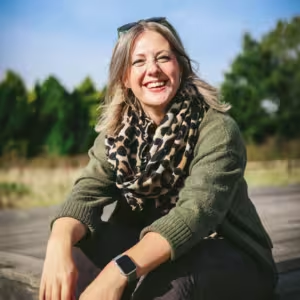
Kate Rostance is a humanist wedding celebrant based in North Wales. She creates ceremonies that are relaxed and full of meaning - with a touch of humour and plenty of heart. She works across North Wales, including Snowdonia, Anglesey, Gwynedd, the Llyn Peninsula, Cheshire and beyond.
Find out more about Kate, her approach to weddings, or what happy couples have said about her.